





When Jenn Abrams moved with her family from the Chicago suburbs to Colorado nine years ago, she looked at real estate in the Denver suburbs and asked what she thought was a very reasonable question: “Where do the Jewish families live?”
The answer came as something of a surprise.
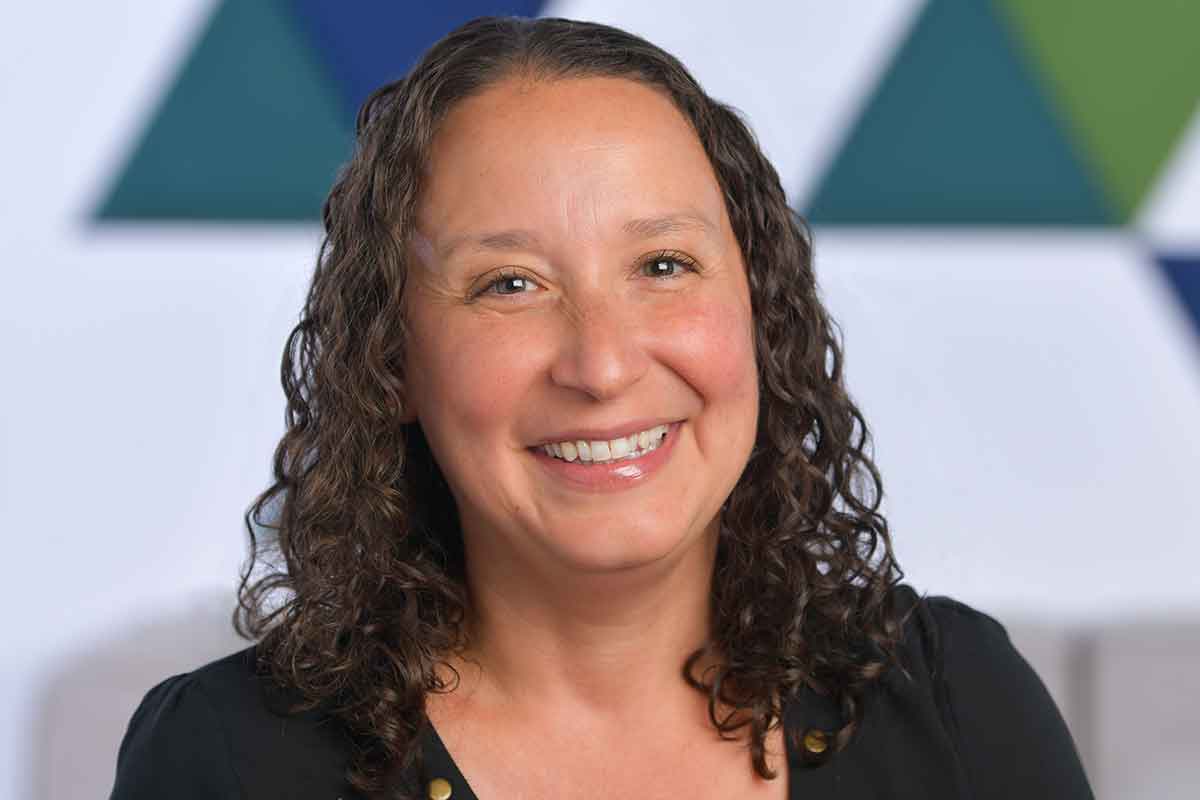 “I remember being told that there was one suburban zip code,” she says with a laugh. “And I said, ‘What do you mean? There is only one zip code?’”
Abrams points out that in the intervening decade, Colorado has changed, but what has not changed is that young families moving to the state are still looking for community—and many of them are finding it through JEWISHcolorado’s PJ Library program.
Now, Abrams will take over as PJ Library Coordinator, running a program that in the last fiscal year mailed more than 5,000 books and hosted more than 150 events.
“Like many PJ Library families moving here, I was once a young Jewish mom looking for community,” she says. “When people talk about the need for connection, it resonates with me because I lived that experience.”
Abrams brings varied professional experiences to her new position, all of which involve families and children. And, as JEWISHcolorado’s new chief storyteller, she also brings a memorable personal story—her own family’s version of “The Diary of Anne Frank.”
The granddaughter of Holocaust survivors
When, as a child, Jenn Abrams was assigned to read “The Diary of Anne Frank” in school, she brought her grandmother to class to serve as a living resource for the students.
Abrams’ grandparents met during WWII in Amsterdam and were married in secret by a rabbi. They connected with the Dutch resistance movement and were hidden in the homes of non-Jews until they were advised to split up to reduce the chances of being discovered. Abrams’ grandmother dyed her hair and spent 15 months living with different families in remote parts of the Netherlands. When it appeared the Nazis were advancing, she walked for three days across the country, returning to Amsterdam where she knocked on the door of a known resistance sympathizer.
At first, the woman who answered the door hesitated, told her to wait, and closed the door. When the door opened again, there stood Abrams’ grandfather. He had been hiding at the home since the two had separated.
“From then on, they stayed in the home together, and it really was like The Diary of Anne Frank,” says Abrams. “They lived in a secret place behind a cupboard and under floorboards.”
Immediately after the war, Abrams’ grandparents were reluctant to talk about their experiences, but over time, that changed, and Abrams’ grandmother shared her story with the Shoah Foundation, Yad Vashem, and the U.S. Holocaust Memorial Museum. Abrams heard her grandparents’ stories from a young age and participated in the International March of the Living as a junior in high school.
“Most of my grandparents’ family died in concentration camps during the war, including my great-grandparents,” Abrams says. “The families that my grandparents became closest with were the ones who helped them survive. They became proxy grandparents to my mother.”
Professional skills
Abrams brings more than 15 years of professional experience to her new position.
She graduated from Northwestern University with a B.S. in Human Development and Psychological Services. She earned a master’s in social work from the George Warren Brown School of Social Work at Washington University.
“I liked the idea of direct service,” she says. “Social work seemed like a flexible field where you can do so many different things.”
She started her professional career at the JCC Chicago, consulting with parents and early childhood educators in preschool programs operating in different synagogues under JCC oversight. She transitioned to hospital-based social work at Shriners Hospitals for Children and the Ann & Robert H. Lurie Children’s Hospital, both in Chicago. Her work ranged from offering care coordination for children with complex orthopedic conditions to providing outpatient support across multiple pediatric specialties.
She took time off between jobs to spend time with her two daughters. They were four and six years old when her husband was offered a new position in Colorado. When the family made the move in December 2016, Abrams became that young mother trying to meet people by enrolling her daughter in Jewish preschool and getting involved in parent organizations.
Through a friend of a friend, she met Bethany Friedlander, the outgoing PJ Library Manager. Friedlander was working at MazelTogether, a Rose Community Foundation program that built community among young Jewish families through programs and events. When Friedlander had an opening at MazelTogether, she recruited Abrams.
“I had been to a MazelTogether Shabbat Dinner, and I was just blown away by the experience,” Abrams says. “People took so much time and effort to help me and my family feel connected.”
In recent years, Abrams has worked at Cottonwood Creek Elementary School as an Early Childhood Instructional Para Educator and a Behavior Regulation Technician. When she heard that Friedlander was leaving JEWISHcolorado to move to another city for her husband’s new job, it seemed that all her personal and professional experiences had prepared her to apply for the position.
“How could I say no to this opportunity?” she says. “I have this drive for the Jewish community because it has done so much for me.”
The PJ Library mission
Abrams believes that now, more than ever, PJ Library fulfills an important goal for families
“Life is so fast paced these days,” she says. “Helping young families find joyful Jewish experiences and build relationships feels like an opportunity to slow down and connect.”
Her two children were PJ Library kids, and she praises the “simplicity of a subscription as an easy touchpoint to add engaging content and Jewish life to your life.” She also knows that Jewish life exists beyond the subscription because it is important to many families to feel that they are part of a larger community by participating in programming.
“There is so much value in connecting families through neighborhoods which PJ Library does with Family Connectors,” Abrams says. “I know because I was once that parent eager to meet other parents.”
Looking to the future, she would like to find ways to reach young people as they age out of the PJ Library program. But at the moment, she is busy learning the ropes of her new position in a Colorado that very definitely now has more than one zip code of Jewish life.