




When Ken Brown and Gail Gross-Brown moved to Denver two years ago, they did serious research before picking their new neighborhood. In fact, they “handpicked our street,” a place where, Ken says, “I don’t feel afraid to put my Hanukkah decorations up, and I don’t feel afraid to have a mezuzah on my door.”
But past experience in their Ohio neighborhood of many years had taught them to remain ever vigilant. Gail experienced terrorism personally when she was in Munich’s Olympic village during the 1972 attack on Israeli athletes, a massacre that killed her cousin.
“We are very proud of being Jewish,” Ken says. “But we are also very aware of the dangers that can come with it.”
That is why the couple has come to JEWISHcolorado on a Thursday evening for the Jewish Community Relations Council (JCRC) and Secure Community Network (SCN) presentation: “Bystander Awareness and De-escalation Training.” SCN is the official safety and security organization for the Jewish community in North America.
“I’m hoping we will learn some new skills because we go to a lot of events,” says Ken. “Are there things we should be looking for that we don’t already know?”
The presentation, led by SCN Regional Security Advisors Kevin Farrington and Brian Maloney, represents the most recent public offering from JEWISHcolorado to help ensure the safety of the Jewish community.
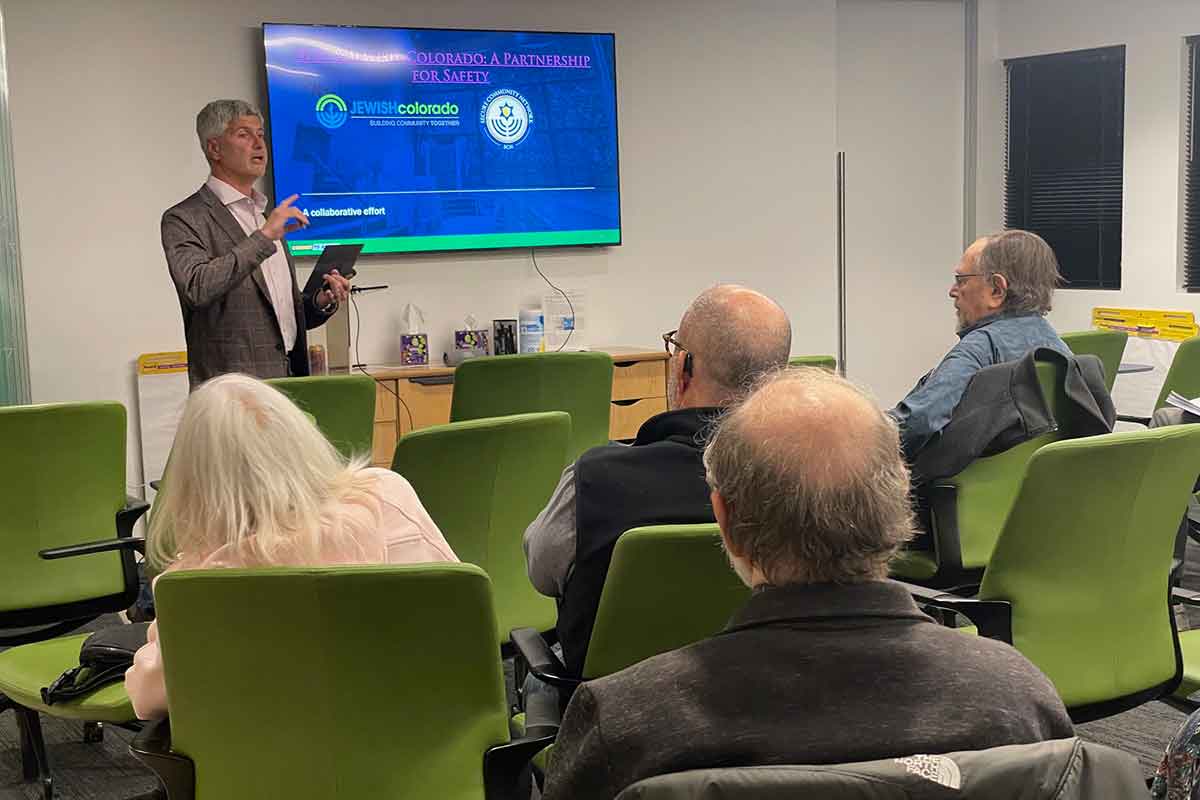
Since Maloney joined the team as a second SCN Advisor in Fiscal Year (FY) 2025, JEWISHcolorado’s Regional Safety & Security Initiative has expanded dramatically.
In FY 2024, SCN did 71 trainings in Colorado. Only five months into FY 2025, the SCN Advisors have already done 251 trainings, an increase of 250% before the year is half finished.
In FY 2024, SCN trained 1,900 participants. So far in FY 2025, they have trained 6,400.
“This very significant increase in people participating in safety and security training tells us two things,” says JEWISHcolorado President and CEO Renée Rockford. “Our community wants to be as well-equipped as possible to head off or handle a crisis, and our SCN Advisors are offering information in their trainings to help achieve that goal.”
Planning and popcorn protests
Brandon Rattiner, Senior Director of the JCRC, began the presentation by noting that since October 7th, there has been an increase in protest events around the Denver metro area, including at a recent pro-Palestinian protest at Cherry Creek Mall. Kevin Farrington put these protests into perspective for his Jewish audience.
“We don’t want people to be afraid,” he told them. “We want people to be more aware.”
In FY 2024, SCN Advisors helped with security at 58 events. In FY 2025, they have already helped with 125 events.
Farrington’s advice for a safe and secure event could be summed up in three words: plan, plan, and plan, ideally with the support of SCN and law enforcement. As you plan, ask key questions:
- How aware is your venue that there is a generalized threat against the Jewish community?
- Does your main speaker carry political baggage that might prompt a protest?
- Are you willing to change your usual safety plan, even if it means not doing things the way you have always done them?
- How are you handling pre-event registration?
- How are you handling the registration desk, the place that Farrington says is the “toughest job—if you think you need three people there, plan to have five people.” Is the desk in a place that cannot be bypassed?
- How are you handling entrances and exits, since a threat can continue after people exit?
- Will you have ID checks and event badging?
And what if, even with all the planning, your event is disrupted?
“The goal is to prevent the situation from escalating further, avoiding potential harm or violence,” Farrington said. “But risk minimization with agitators and disruptions is not easy. Your own safety should be your priority.”
The actions of protestors determined to shock and disrupt often defy logic and reason, so reasoning with them may not be an option, Farrington said. They often resort to the “popcorn tactic” with one protestor escorted out for disrupting, only to be followed up by another one popping up to disrupt the event, and another one after that person is escorted out. And on it goes.
“They want to generate an aggressive—or even violent—response,” Farrington said. “You should assume you are being recorded on video and audio by them, and they will pursue criminal or civil action against you if they can.”
Farrington’s advice to someone in the middle of an infuriating popcorn protest? Limit physical engagement, speak in a calm and friendly tone, and use law enforcement and private security to remove the protestors for trespassing.
Situational Awareness
SCN Advisor Brian Maloney presented a condensed version of the excellent SCN training on situational awareness.
“Situational awareness means you have strength and confidence through preparedness,” he said. “It means that if something bad happens, you will react and fall back on your level of training.”
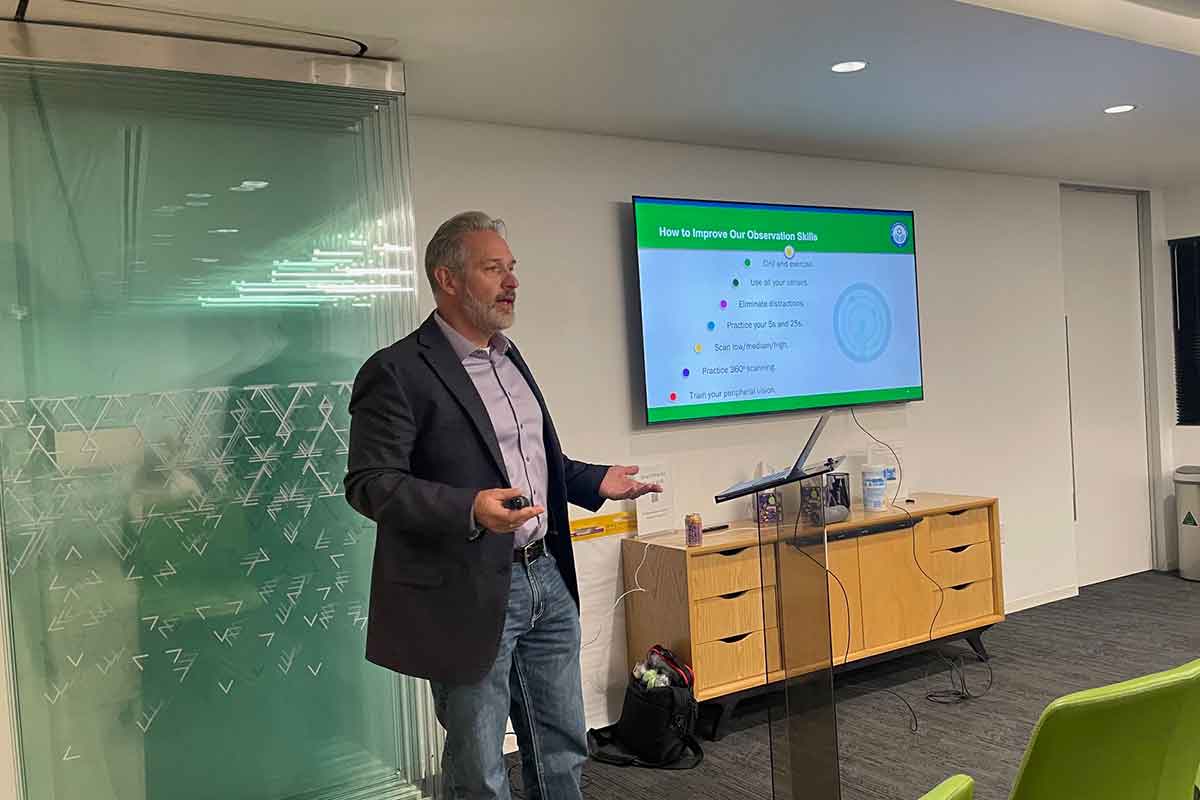
Maloney described the distractions that get in the way of situational awareness—with mobile phones and complacency in the lead. Without situational awareness, Maloney pointed out, people often respond to a threat by freezing in place.
“I don’t want that to happen to anyone in this room and that is why we are here,” he said. “Paralysis is bad, and it doesn’t lead to anything good.”
This fiscal year, SCN Advisors have already done 33 security drills with organizations before the year is half finished. By comparison, in FY 2024, they did seven drills. The addition of a second Regional Advisor has meant that more people are trained and have more confidence in their ability to respond on what might be the worst day of their lives.
“Criminals are opportunistic,” Maloney said. “Situational awareness and paying attention are at least 80 percent of the solution because they afford you more time to make decisions. And the more time you have to make a competent and informed decision, the better that decision will be.”