




Courageous Leadership, a partnership between JEWISHcolorado and the Shalom Hartman Institute, provides what is becoming an increasingly rare experience in polarized and partisan times. Now in its fifth year, Courageous Leadership asks people to speak their minds on the most difficult topics with one caveat—differing opinions must be received with civility.
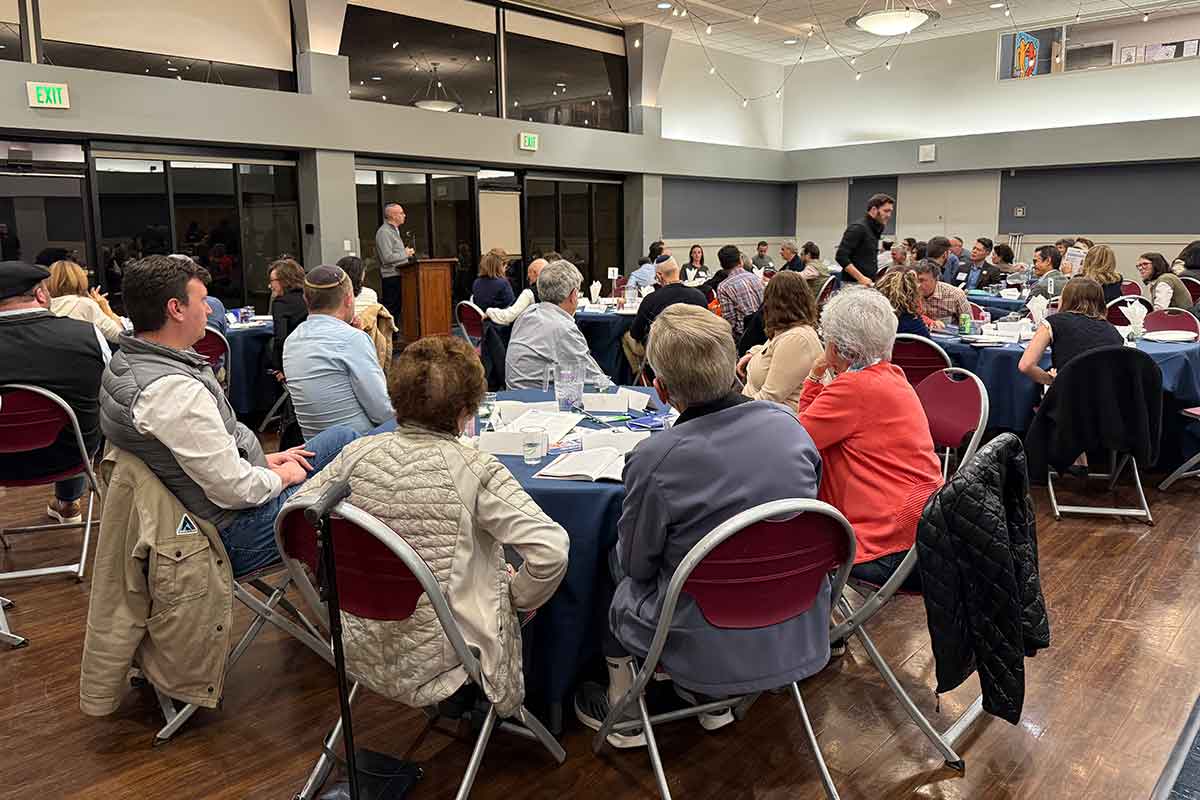
On Thursday, November 6, nearly 80 members of the community gathered for an opening event in the 2026 Courageous Leadership program, held at the Staenberg-Loup Jewish Community Center. The evening was led by Dr. Yehuda Kurtzer, President of the Shalom Hartman Institute and a leading thinker and author on the major challenges facing the Jewish people.
Renée Rockford, President and CEO of JEWISHcolorado, established the premise of the evening in her introduction of Dr. Kurtzer.
“If ever there was a moment when we as a community and as a people are seeking help in navigating these times, that moment is now,” Rockford said. “We all know that we need space to gather, learn, and strengthen one another. So tonight, we have a timely and courageous conversation with depth and sophistication about what it means to lead with moral clarity, to speak authentically across differences, and to hold together a diverse Jewish community in these challenging times.”
Dr. Yehuda Kurtzer, round one
Kurtzer began by referencing Maimonides’ codification of Jewish law and the question a court would ask of someone wanting to convert to Judaism.
“This a downtrodden and vulnerable people, subject to persecution throughout history. Do you nevertheless want to be part of this people?”
“You have to remind someone that they are getting a raw deal to belong to the Jewish people,” Kurtzer said. “When someone acquires a Jewish identity, they are linked to the perception of Jewish vulnerability.”
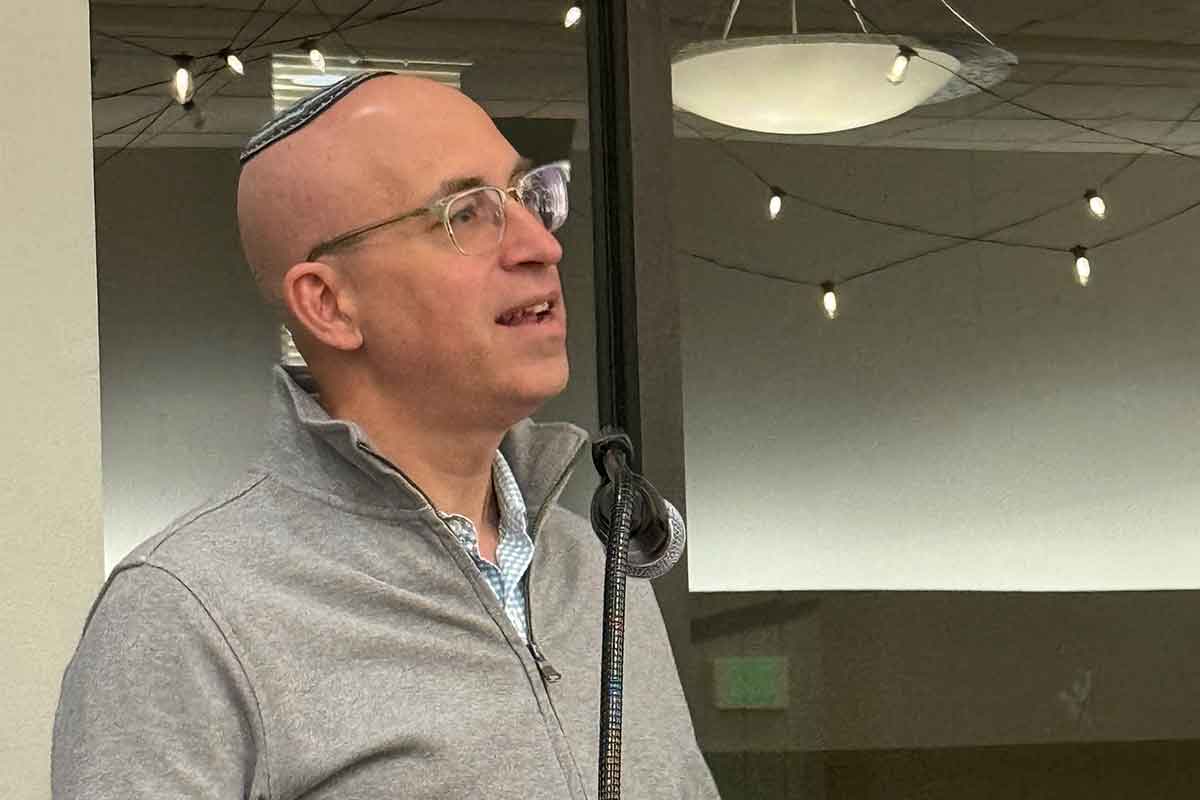
This sense of vulnerability—that enemies are at the gates and safety can disappear overnight—was exacerbated by the attack of October 7th and the normalization of a culture of antisemitism, Kurtzer continued. In theory, he said, the response would be for Jews to bond, with the story of a shared vulnerability creating a phalanx of safety. Kurtzer recounted how he was amazed at the many powerful ways the Jewish community came together after October 7th as an expression of solidarity.
“But what happens when we perceive that it is other Jews who are not making us safe?” Kurtzer asked. “How do you build a bridge to people you think are morally wrong, politically wrong, and who you believe might actually be endangering you?”
When the questions of danger and safety move from the external threats to the internal conflict, the result, Kurtzer pointed out, is that people might leave Jewish community or be unwelcome in some Jewish spaces.
Kurtzer then turned to the group of listeners and put the question to them for discussion. “Where is the climate of safety and danger playing out in our community?” he asked. “This activity tonight is premised on trying to make the claim that we are stronger collectively despite our differences or maybe because of them. How is this showing up for all of you?”
Courageous Leadership, round one
At each table, Kurtzer’s message prompted a wide range of responses, often based on personal experiences.
At one table, there was immediate discussion of the events of the attack on Run for Their Lives marchers in Boulder which led to the death of 82-year-old Karen Diamond.
There was also discussion of the role social media plays in today’s society. For one person, the best way to feel less threatened was to simply leave engagement with social media.
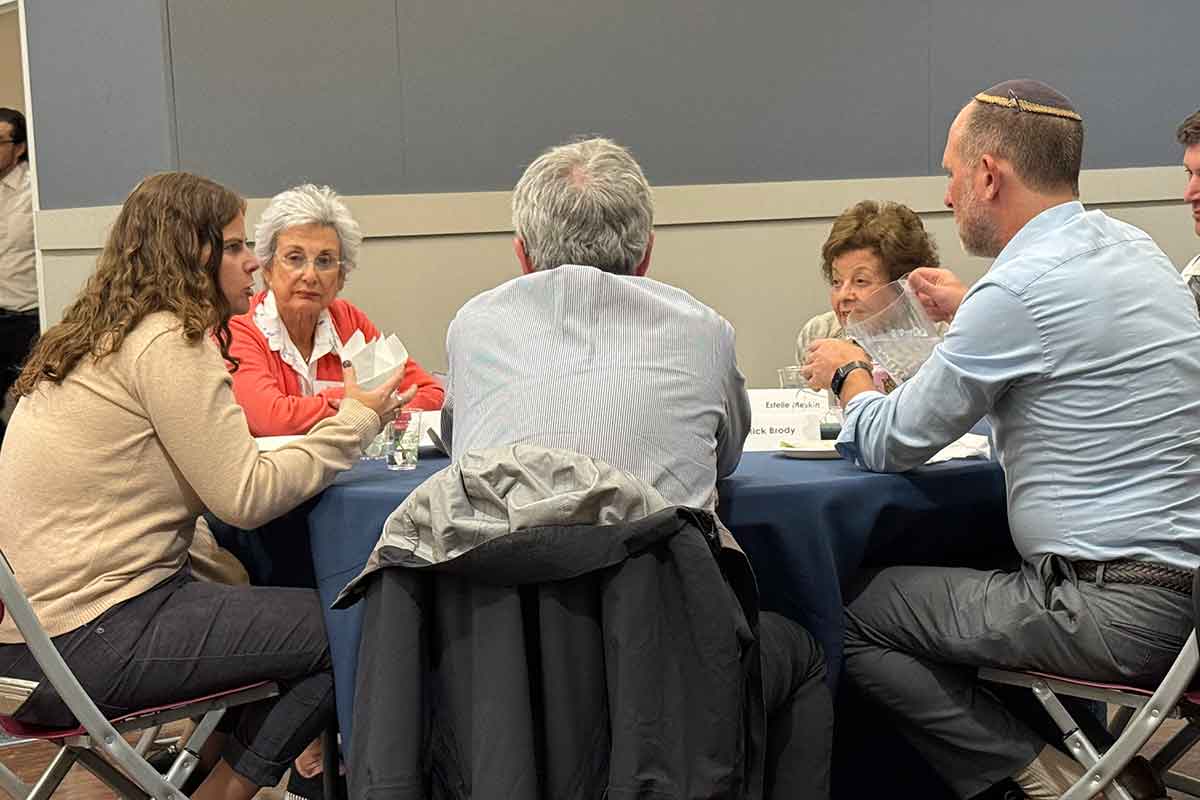
As the conversation intensified, one participant put a question to the group in plain terms: “Is there space for people who do not support all the actions of Israel?”
The term “enforced purity test” came up frequently in the group. “I feel like even if people don’t know me, they judge me,” said one participant. “I am progressive, but am I progressive enough?”
There was genuine pain at the table as one participant recounted their struggle to find “joyful Jewish interactions” as a Jewish professional in the wake of October 7th.
While there was emotional heaviness in the conversation, there was no anger, no bitterness, no criticism, no hostility. There was simply a candid exchange of experiences and opinions.
Dr. Kurtzer and Courageous Leadership
In the second round of his presentation, Kurtzer’s most used terms were “big tent” and “audacious hospitality.”
He recalled the incident in January 2022 at Congregation Beth Israel in Colleyville, Texas, where Rabbi Charlie Cytron-Walker invited a man into the synagogue who appeared to be unhoused. The rabbi made him a cup of tea, and the man produced a gun and took four hostages.
“Asked about this story afterwards, Rabbi Cytron-Walker said that, given the same situation and knowing what he knew then, he would do it again,” Kurtzer told the room.
In his thinking, Kurtzer said, the rabbi represented the ultimate success of the American Jewish project for the past 40 years by building a “big tent” and offering “audacious hospitality.”
Kurtzer used this story to ask a series of questions. How do we create an atmosphere where people want to enter? How can we create a community of consent rather than obligation? How can we give people avenues to participate? Will we continue to embrace a big tent ethos, inclusive of anyone, given that there are safety and security risks? What risks are we willing to incur?
Again, Kurzer gave members at each table the opportunity to discuss the concept of a big tent. Again, participants had their own questions.
“Can you be everything to everyone?”
“What happens to shared values? Won’t they become diluted?”
“How can I understand the views of people who think that Israel is committing genocide?”
“Who gets to make the decision about who is endangering me? What if I think some Israeli political leaders are endangering me?”
“At the macro level, there are some people with views outside the pale. Are we going to exclude them from the big tent?”
“The loudest voices at each end of the political spectrum are the ones that get all the attention. People don’t even want to have conversations. They just post on social media.”
Repeatedly, the group talked about the pain of families torn apart—close relatives who are experiencing some form of family exile—because of their viewpoints about the way Israel fits into their Judaism. Again and again, individuals expressed frustration with failures of communication.
But Courageous Leadership is a place where conversations are still occurring—fiercely, but also peacefully and civilly.
Kurtzer left his audience with one final thought.
“In the tension between inclusion and safety, there is a third value and that is care,” Kurtzer said. “We depend on Jewish community because they are places where we can be cared for. By belonging to Jewish community, we are granted the nobility of caring for others. Communities that prioritize care for members experience fewer tensions about what people believe.”